Short answer: Winter foraging in the UK comes down to a few hedgerow fruits that hang on after the leaves fall, not a basket of fresh greens. Rose hips, hawthorn haws and sloes are the finds most beginners can learn. Sweet chestnuts and crab apples belong to the start of winter, and only if you can separate them from poisonous lookalikes. If you are not certain of the plant, do not eat it.
In this guide
- What winter foraging in the UK looks like
- Rules before you pick
- Five easier winter finds
- Berries and plants to leave alone
- How to pick without stripping the hedge
- What to do when you get home
- FAQ
What winter foraging in the UK looks like
By the time winter settles in, the soft picking has mostly finished. The plants that remain easy to see are woody: bare stems, thorns, hips and a few stubborn fruits. That can be a kinder season for a beginner than high summer, because there is less foliage to hide the shape of a shrub. It is a worse season for guessing. Berries stay bright so that birds will find them, and that brightness covers both traditional wild foods and plants that poison people.
Quality slides as the weeks pass. In early winter you may still find firm rose hips, sound haws and sloes with a clear pale bloom. After repeated frost, rain and flocks of fieldfares or redwings, the same hedge can be down to shrivelled skins. Use what is in front of you. A mild December in the south-west is not a December in the Scottish Highlands, and one cold week can clear a stretch of hedge.
Treat these walks as lessons first. Note the bush, the thorns, the buds and what the fruit looks like when you cut it open. Pick only when that picture matches a plant you have already learnt, and pick only a little. A sure identification and a handful of fruit is a better result than a full bag.
Rules before you pick
Read the safety rules before you pick, not after. Foraging Safety: The Rules That Keep You Alive is the longer version of the habit this article keeps repeating: identify from several features, eat a small amount of any new food only once you are sure, and leave anything that does not match.
Place and permission come next. A public footpath gives you a route across land, not a right to strip the hedge. Farmland, gardens and private woods need the landowner’s permission. Plenty of parks, churchyards and nature reserves forbid taking plants under local bylaws, even where rose and hawthorn are everywhere. If a site is protected, assume extra rules apply until you have checked. The Woodland Trust foraging guidance is a clear public starting point for picking with restraint.
Know the baseline law. Under the Wildlife and Countryside Act 1981 it is an offence to uproot a wild plant intentionally unless the landowner has allowed it. Some rare species are protected from any picking. The fruits in this article are common, and taking a few hips is not the same as digging up a root. Common does not mean unrestricted.
Then identify the plant properly. One red berry is not an identification. Look at thorns, bark, the stalk and the inside of the fruit, and compare those details with a field guide at home in good light. Do not taste a fruit to work out what it is. Some poisons in British hedges and wet ground can do serious harm in a small amount. If you are still choosing where you are allowed to walk, Foraging Maps and Resources: Tools for Finding Wild Food Nearby covers maps and access. A map can keep you off the wrong land. It cannot tell a sloe from a privet berry.
Five easier winter finds
Five plants are enough for a first winter. All are widespread in ordinary hedges, woods and field edges. None of them is a raw snack. Learn one at a time, and ignore everything else until these are familiar. If a single feature fails to match, leave the whole bush.
| Plant | Signs that fit | Leave it if |
|---|---|---|
| Wild rose | Elongated orange-red hips, curved prickles, several hairy seeds | The fruit is a red cup on an evergreen, or the leaves are spiny and holly-like |
| Hawthorn | Small round red haws, true thorns, usually one seed, mealy flesh | Berries sit on a spineless evergreen |
| Blackthorn | Blue-black sloes with a bloom, one stone, long thorns, dark twigs | Berries are small, shiny and black, with no plum stone |
| Sweet chestnut | Densely spiny husk and a pointed nut with a small tuft | The nut is round with a large pale scar, or the husk has only short sparse spikes |
| Crab apple | A small apple with a core and pips, on a tree without thorns | The cut fruit has no apple core |
Rose hips
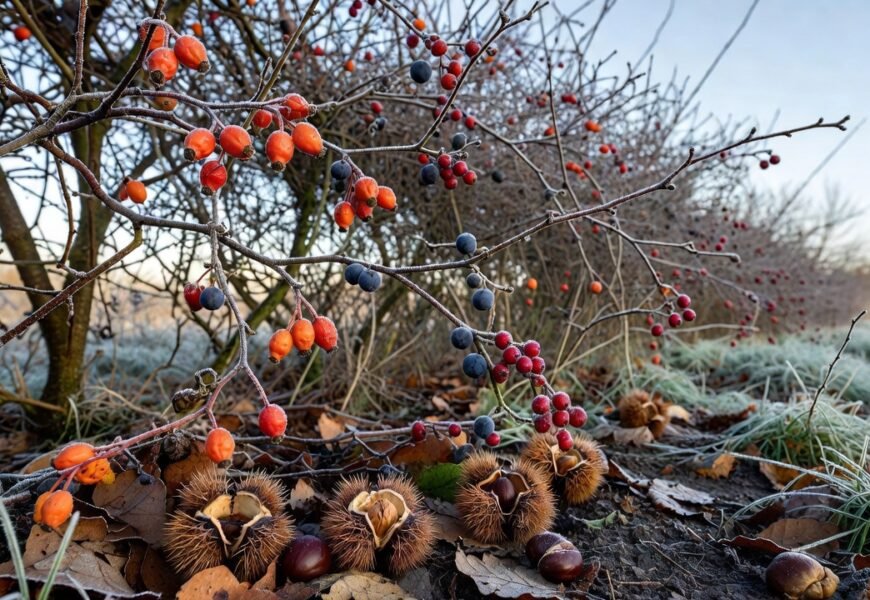
Dog rose and other wild roses hold hips that turn orange-red and often stay on the arching stems after the leaves have gone. A typical hip is longer than it is wide, on a stem with curved prickles rather than long straight thorns. Split it and you should see several hard seeds in a mass of fine, pale hairs. Those hairs irritate the mouth and gut, which is why a raw hip is a bad experiment.
Use hips cooked and strained, usually as syrup or jelly, and remove every seed and hair. Rose hips are a traditional winter fruit and a well-known source of vitamin C. That is not a medical claim, and it is not a reason to skip identification. A red fruit on an evergreen, or a red cup with one seed showing, is not a rose hip. Those are yew and, in the spiny-leaved case, holly. Leave both.
Hawthorn haws
Common hawthorn is a hedge tree with sharp thorns and clusters of small, round, deep red fruits. The haw often keeps a tiny dried remnant of the flower at the tip. Cut one and the flesh is mealy, with a single hard seed in the usual hedge species. Midland hawthorn, which is less dominant in the open hedge, can have two seeds. Either way, people sieve the flesh for jelly and discard the seeds. The fruits are bland, not poisonous when they really are haws, and they are not worth eating straight from the twig.
Thorns are part of the identification and part of the hazard. They are shorter than a blackthorn’s worst spines, but they still go through thin gloves. In winter, without the lobed leaves, lean on the thorns, the cluster of red haws and that single seed. Holly berries are also red, and they grow on a glossy evergreen with spiny leaves and no thorns of the hawthorn kind. If you are looking at an evergreen, stop.
Sloes
Sloes are the fruit of blackthorn. They are round, about the size of a small marble, and blue-black under a whitish waxy bloom that rubs off on your fingers. Inside is one plum-like stone. The twigs are often very dark, and the thorns are long and sharp. Bite a correctly identified sloe raw and it is harshly astringent, drying your mouth. That pucker is normal for sloes. It is not a safety test you should use on an unknown berry.
A frost is traditional because freezing softens the fruit and takes the edge off that dryness. It does not “make sloes safe”. If the weather stays mild, people put clean, identified sloes in the freezer and then steep them with gin and sugar. That is a long-standing country habit, not a rule that every blue-black berry is a sloe. Privet, which is common in hedges, carries small shiny black berries that are poisonous. Privet has no long thorn and no single large stone. If you cannot find both, do not pick.
Sweet chestnuts
Sweet chestnuts are really a late autumn crop that lingers into early winter if squirrels, people and wet weather have not taken them. The tree is widely planted and naturalised in parks and woods. The ripe husk is a dense ball of long, sharp spines, closer to a sea urchin than to a conker case. Inside, the nuts are pointed, with a small tuft at the tip, and a husk often holds two or three of them. A grocer’s sweet chestnut is a useful shape to study at home. It is not, on its own, proof of what you have found outside.
Horse chestnut, the conker tree, is the lookalike that matters. Conkers are rounder, with a large pale circular scar, and they sit in a thick husk with short, widely spaced spikes. They are not a food. Eating them can make you ill. Only take a nut you can match to a densely spiny husk on the ground beside it, because parks sometimes contain both trees. Discard nuts with holes, and any that smell sour or musty once shelled. By deep winter, assume fallen nuts are past their best unless they are still hard, fresh-smelling and recently dropped.
Crab apples
Wild crab apples and feral orchard apples both turn up in hedges. The useful winter clue is simple: the fruit must be an apple. Look for a dimple at the stalk and at the base, a tree without thorns, and, when you cut the fruit, a core with pips. Hawthorn and blackthorn can stand in the same hedge, but both are thorny and neither has an apple core. Many crab apples fall before winter. A few cling on after a mild autumn. They are sour. Cooking them into jelly or a thick butter is the normal use.
Do not eat the pips. Apple seeds contain compounds that can release cyanide if they are crushed and eaten in quantity. Strain them out. A pip swallowed whole by accident is not the same as blending a bowl of seeds, but there is no benefit in eating them. If the cut fruit is not an apple, throw the idea away with the fruit and wash the knife. Do not nibble the offcut.
Berries and plants to leave alone
Winter hedges are full of fruit you should not experiment with. The plants below are common, easy to walk past, and a bad place to be casually curious. This is not a full poisonous-plant list. It is the set most likely to sit beside the finds above.
- Yew. An evergreen with flat, dark needles, often in churchyards and old hedges. The red aril looks like a small open cup with a seed in the middle. Treat every part of yew as highly poisonous. Eating leaves, seeds or other parts can be fatal. Do not taste the red flesh “just to see”.
- Holly and ivy. Holly has red berries on spiny evergreen leaves. Ivy has black berries on climbing woody stems. Both are poisonous to people. Ivy berries are a winter food for birds, which is another reason to leave the cluster intact.
- Privet and snowberry. Privet’s small black berries and snowberry’s white berries are not wild food. Mistletoe, with its white berries on a tree branch, is poisonous too. White winter berries are a leave-alone colour for beginners.
- Lords-and-ladies. Also called cuckoo pint. In winter you may see a low spike of bright red berries in woodland. The plant is poisonous. Do not tidy it into a basket because it looks like a cluster of beads.
- Anything in water. Hemlock water-dropwort grows in ditches, wet meadows and along streams and is one of the most poisonous plants in Britain. Do not dig roots, and do not start your foraging with leaves or stems from wet ground.
- Fungi. A few species fruit in cold weather, but so can the funeral bell, a deadly mushroom that grows on wood. Winter fungi are not a beginner project. Leave them until someone experienced has confirmed an identification in person.
Bright berries are also a child-height problem on an ordinary pavement. If you are out with children, the useful rule is that nothing goes in a mouth on the walk, including foods you know, until you are home and the identification is settled. Pets will also eat dropped fruit. Do not scatter leftovers from a “maybe” bush.
How to pick without stripping the hedge
Those same hips, haws and sloes are winter food for thrushes, blackbirds, mice and other wildlife. A bush that looks heavy with fruit in November can be a store that has to last for weeks. Take a light scattering from several plants, not every hip from the nearest one. If a shrub only has a handful, take none. If birds have already opened most of the fruit, leave what remains.
Pick fruit, not branches. Do not break leaders off a blackthorn, and do not uproot anything. A small basket or an open bag beats a sealed plastic sack, which sweats and crushes the fruit before you get home. Keep away from busy road edges, where fruit is coated in dust, and from corners that dogs use constantly. Washing helps with surface dirt. It does not repair a wrong identification, and it does not make roadside grime a non-issue.
Gloves are worth wearing. Blackthorn punctures can go deep and turn sore. Clean any wound, and seek medical advice if it swells, throbs or fails to settle. While you are there, you are still a guest in a living hedge: close gates, do not block a footpath with your bag, and do not trample the margin to reach one more branch.
What to do when you get home
Spread the fruit out in good light and check it again before it goes near a recipe. Photograph the twig, the thorns and a cut fruit if you want a record to compare with a guide. Anything that does not match the plant you intended goes in the waste, not into the pot “in case it is fine”. Cook only one new wild food at a time, in a small portion, so that if it disagrees with you, you know what you ate. People who react to apples, plums or other rose-family fruits should be especially cautious with crab apples, haws and sloes.
Preparation is ordinary kitchen work, not a purification ritual. Rose hips need the hairy seeds removed or a thorough strain through a cloth you can afford to throw away. Haws are simmered and sieved. Sloes are traditionally pricked, or frozen in a mild year, then steeped. Sweet chestnuts are scored and roasted or boiled, never eaten as conkers. Crab apples are cooked and the pips strained out. If a nut smells musty, or a hip is fermenting and black with mould, compost it.
None of this turns a doubtful plant into a safe one. The standard stays the same from the hedge to the kitchen: if you are not completely sure, you do not eat it. A winter spent learning five shrubs, and walking past the rest, is a successful season.
FAQ
Is winter worth it for a complete beginner?
Yes, if you treat it as a short syllabus rather than a treasure hunt. Bare twigs make the shape of roses, hawthorn and blackthorn easier to learn, and the fruit is visible. The trade-off is that several poisonous berries are just as visible. Stick to a few plants and expect some walks to be looking only.
Can I pick rose hips and sloes on any footpath or in a park?
No. You need the right to be on the land, and many parks and reserves ban foraging in their bylaws. Private hedges need the landowner’s permission. Uprooting wild plants without that permission is illegal. If you cannot see who manages the site, leave the fruit.
Do sloes have to be frosted before I pick them?
Frost is about texture and sharpness, not about turning a sloe into something else. Unfrosted sloes are still sloes if the bush is blackthorn, and they are still mouth-drying. Freezing identified fruit at home is the usual substitute in a mild winter. Frost does not make an unknown black berry safe.
Are any red winter berries safe to eat raw?
Do not use colour as permission. Haws and rose hips are red and are traditional foods once prepared, but raw hips irritate because of their hairs, and raw haws are mealy and full of seed. Yew and holly are also red, and they are plants to leave completely. Unknown red berries do not get a trial taste.
Should I try winter mushrooms if the guide looks convincing?
No. Printed and online guides are a place to study, not a substitute for an identification you can defend feature by feature. Deadly fungi, including the funeral bell, can fruit on wood in cold months and share a habitat with species people eat. Leave fungi until you have in-person help.
What should I do if I think I have eaten the wrong plant?
Do not wait to see what happens, and do not try home remedies or make yourself sick unless a clinician tells you to. If someone is seriously unwell, confused, struggling to breathe or has collapsed, call 999. Otherwise contact NHS 111 and say exactly what was eaten, and when. A clear photo, or a bagged sample of the same plant, can help the people advising you. Do not eat any more.
Sources
- Woodland Trust: foraging. Responsible foraging advice from a major British woodland charity, including restraint, identification and the law around wild plants.