Short answer: Search results for foraging law UK often mix up England, Wales, Scotland and Northern Ireland. In England and Wales, section 4 of the Theft Act 1968 means that picking wild mushrooms, or flowers, fruit or foliage from a wild plant, is not theft when it is not for reward, sale or any other commercial purpose. That is an exemption from theft, not permission to enter land or to uproot plants. The Wildlife and Countryside Act 1981, byelaws and protected-site rules still apply. This is general information, not legal advice.
In this guide
- England and Wales, and not legal advice
- The Theft Act exemption
- What the picking rule does not cover
- The Wildlife and Countryside Act
- Protected sites
- Byelaws and site rules
- Permission, trespass and access
- Checks before you pick
- FAQ
- Sources
England and Wales, and not legal advice
The law in this article is the law of England and Wales. Scotland’s Land Reform (Scotland) Act 2003, and the Scottish Outdoor Access Code, treat public access and personal picking of wild fungi, fruit, flowers and foliage differently. Northern Ireland has its own wildlife law and its own access rules. A page that says UK, then describes the Scottish code, is the wrong guide for Kent or for Eryri.
England and Wales share the Theft Act 1968 and the Wildlife and Countryside Act 1981. The bodies you meet are not the same. Natural England deals with Sites of Special Scientific Interest in England. Natural Resources Wales does so in Wales. Councils, National Park authorities and landowners add byelaws and conditions on top.
This is not advice on your own facts. A boundary, a common, a military training area or one sentence of a byelaw can change the answer. Statutes are amended. Use the Sources links and read the current text.
The Theft Act exemption
Foragers usually mean section 4(3) of the Theft Act 1968 when they say that picking wild food is legal. In plain terms, a person who picks mushrooms growing wild on any land, or who picks flowers, fruit or foliage from a plant growing wild on any land, does not steal what they pick, even though they do not possess the land, unless they do it for reward or for sale or other commercial purpose. Read the current words: Theft Act 1968, section 4.
The exemption is only a shield against a theft charge. It is not a right to enter land, and it does not make a footpath into a harvest strip.
Picking, not severing
The same section says that if you are not in possession of the land, you can steal something forming part of the land by severing it, or by taking it once severed. The picking rule is the exception, and only for what you pick. The Act never defines “picks”. A berry, a leaf or a mushroom cap is picking in ordinary English. Digging the plant out, cutting timber, or taking a branch away is severing. If you needed a spade, you are very likely outside section 4(3).
Growing wild
Gardens, allotments, orchards, vineyards and farm crops are not growing wild. Nor, usually, is a hedge someone planted and still maintains. A self-sown tree on a rough margin is a more honest fit. If you cannot tell, ask or leave it. Fruit does not become wild because it hangs over a footpath from a garden tree. That fruit belongs to the owner of the tree. Windfall apples on the pavement from that same tree are not a gift from section 4(3) either. The exemption is about picking from a wild plant, not about fallen fruit from a cultivated one.
Mushrooms, and commercial purpose
Mushrooms growing wild are named separately. Cultivated fungi are not in the exemption.
There is no weight limit. Purpose is the test. Soup at your own table can fall inside the exemption if the other conditions are met. A restaurant, a stall, or picking done as the thing a customer has paid for, is commercial territory. The phrase in the Act is “for reward or for sale or other commercial purpose”. Get written permission, and do not lean on section 4(3).
Without the exemption, taking plants you have no right to take can be theft, a criminal offence. In the Crown Court the maximum is seven years’ imprisonment. Magistrates have lesser powers.
What the picking rule does not cover
The list in section 4(3) is mushrooms, flowers, fruit and foliage. Berries are fruit. Foliage means the leaves and similar growth, not the crown, the timber or the roots. Nuts are not named. Botanically a nut is a fruit, and plenty of people pick hazelnuts on that reading, but the safer reading of the statute is its own list.
Roots, bulbs, turf, soil, moss pulled off in sheets, and wood are outside that list. They raise the severing rule and, where you uproot a plant, the Wildlife and Countryside Act.
The seashore needs a separate thought. Foreshore usually has an owner. Commercial seaweed harvesting is commonly handled by licence, not by the blackberry rule, and coastal byelaws and marine protected areas may apply. Do not assume a bag of seaweed is covered because seaweed grows untended.
The Wildlife and Countryside Act
The theft question and the plant-protection question are different. You need a yes to both. Section 13 of the Wildlife and Countryside Act 1981 is the plant section: Wildlife and Countryside Act 1981, section 13.
Subject to the defences in that Part, it is an offence to intentionally pick, uproot or destroy a wild plant on Schedule 8. It is also an offence, unless you are an authorised person, to intentionally uproot any wild plant. The Act has been amended. Read the current subsection and see whether it says “recklessly” as well as “intentionally” for Schedule 8 plants.
Uprooting is the part people miss. A few leaves from a common plant can be lawful. The same plant pulled up by the roots is not, unless you are an authorised person. Bulbs and saplings for the garden count as uprooting.
An authorised person means the owner, the occupier, or a person they have authorised. Some official authorisations also count, so read the definition in the Act. Custom is not consent.
Schedule 8 is a list with notes, and it is amended. It is aimed at rare plants, including orchids. Some lichens, mosses and other lower plants have been on it. If you are not sure of the species, leave it.
Do not dig native bluebells and do not sell them. Uprooting is already unlawful without authority. Schedule 8 has long restricted selling native bluebells and their bulbs, with a note that can limit the picking rule. Read the current note rather than relying on this summary.
Selling a Schedule 8 plant, offering it for sale, or possessing or transporting it for sale, can be an offence. Parts and derivatives are included, and so is an advertisement offering to buy or sell them. In sale proceedings the plant is presumed wild unless the contrary is shown.
A person is not guilty of the section 13(1) offence if they show that the act was an incidental result of a lawful operation and could not reasonably have been avoided. That is a narrow defence to prove, not a reason to go foraging.
The same Act protects wild birds, nests in use or being built, and eggs. A lawful leaf is not cover for damaging a nest. Identification is a separate problem: a plant can be legal to pick and still be a bad idea to eat, which is the subject of Foraging Safety: The Rules That Keep You Alive.
Protected sites
Place can outlaw a pick that the two Acts would otherwise allow.
On a Site of Special Scientific Interest, intentionally or recklessly damaging the features the site was notified for can be an offence. That can include plants that are not on Schedule 8. Read the citation or ask the manager before you forage a flowery field.
Designations stack. One wood can be an SSSI, a National Nature Reserve and a Special Area of Conservation. A local nature reserve will often have its own rules. National Parks, and National Landscapes (formerly AONBs), do not by themselves ban foraging, but they are full of private land and protected sites. The name on the sign is not a permit.
Check a current official map of designations and access land. Foraging Maps and Resources: Tools for Finding Wild Food Near You sets out how those tools fit together. A map still does not give you the landowner’s permission.
Byelaws and site rules
Byelaws are local laws for particular pieces of land. Councils use them for parks and some commons. The National Trust, the public forest estate, military land and some nature reserves have their own. A byelaw can ban picking flowers, fungi or anything at all, even where the Theft Act exemption would have applied. Breaking a byelaw is an offence. The fine is set by that byelaw, so read the board or the published text instead of guessing.
The New Forest’s byelaws restrict fungi picking. Epping Forest has restricted it too. Those are examples, not a full list. Your nearest common may be stricter or silent. Where a reserve’s rule is a condition of entry rather than a byelaw, it still binds you, and you can be required to leave. A “no foraging” sign does not have to quote a statute to be clear.
Permission, trespass and access
None of the exemptions above lets you onto land. If you have no right to be there, turn around.
A public footpath or bridleway is a highway for passage, not a foraging right. Picking fruit from a wild plant as you pass can sit inside the Theft Act exemption, provided you do not uproot, sell, damage a nest or break a byelaw. Leaving the path for a field, a garden or an orchard is a different matter. You are then on someone else’s land.
Open access land under the Countryside and Rights of Way Act 2000 gives a right to walk on mapped land. It does not give a right to take plants or fungi. General restrictions in that Act put damaging or removing plants outside the right. Forage there without a separate permission and you can lose the statutory right to be present at all.
Ordinary trespass in England and Wales is usually a civil wrong. The occupier can tell you to leave. Separate criminal trespass offences exist for particular places and conduct.
If money is involved, get permission in writing from the owner or occupier, stating what you may take and whether you may sell it. Silence, an open gate or a trodden shortcut is not a yes.
Checks before you pick
Use this before you pick. Any “not sure” means leave the plant.
- Confirm you are in England or Wales.
- Confirm you may be on the land, and that no sign, byelaw or reserve rule forbids picking.
- Pick only mushrooms, flowers, fruit or foliage from a wild plant, and do not uproot.
- Skip anything you cannot name, anything that might be on Schedule 8, and anything a protected site is notified for.
- Keep it personal. If it is for sale or for a paid activity, get written permission first.
- Leave nests alone, and leave plenty of the plant.
FAQ
Is it legal to pick blackberries on a public footpath?
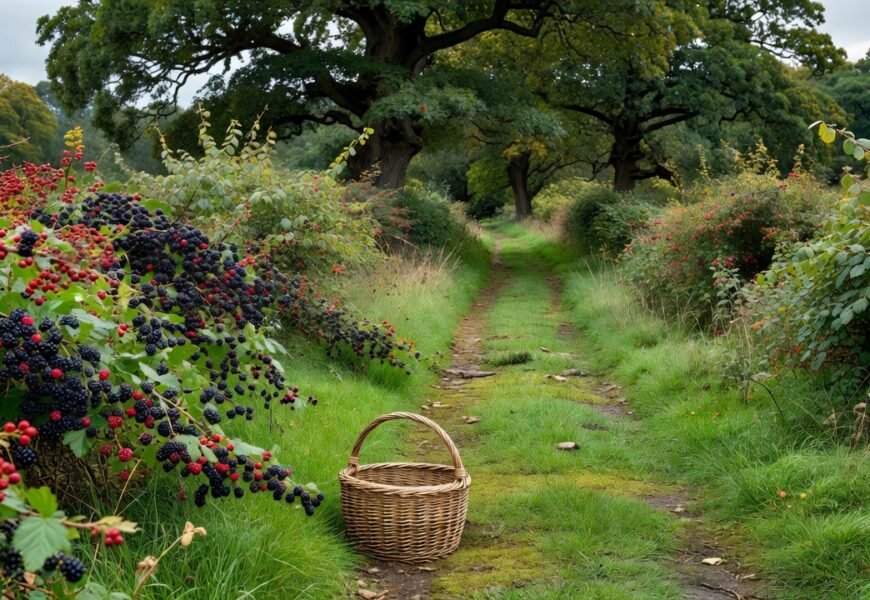
Often, if the bush is wild, you only pick fruit for yourself, and nothing forbids it. A footpath is a right of passage, not a right to enter the field. A garden plant does not become wild by overhanging the path.
Can I sell wild garlic or other foraged plants?
Not under the Theft Act exemption, which excludes reward, sale and other commercial purposes. You need a right to take the plants, normally the landowner’s permission. Schedule 8 can make sale a separate offence.
Is there a legal weight limit for personal foraging?
No. Section 4(3) does not set a weight. It asks whether the purpose is reward, sale or another commercial purpose. Informal advice to take only a little is conservation guidance, not a statutory quota. A small punnet for sale is still outside the exemption.
Are bluebells protected?
Uprooting them without authority is unlawful. Selling native bluebells and their bulbs is restricted under Schedule 8, which has used a note to qualify picking as against sale. Read the current note. Do not dig them.
Does the right to roam include foraging?
No. The Countryside and Rights of Way Act 2000 gives access on foot to mapped land. It does not give a right to take plants or fungi. Wildlife law and any byelaw still apply.
Sources
Read these two provisions in full. Other rules discussed above, including byelaws and access law, sit in different texts. This is general information, not legal advice.
- Theft Act 1968, section 4, on property, severing, and the wild picking exemption.
- Wildlife and Countryside Act 1981, section 13, on protected plants, uprooting and sale.